
Frequently Asked Questions
Ultrasonic cleaning is a powerful, non-destructive method for removing contaminants from complex parts. Whether you are in a medical lab, an automotive shop, or a jewelry studio, our answers to frequently asked questions cover the answers to your questions about maximizing your ultrasonic cleaner’s performance.
Getting Started
To achieve professional results, here are important points:
- Baskets are strongly recommended: Never place parts directly on the tank bottom. This dampens ultrasonic effectiveness and may damage the tank. Exceptions: Large parts can rest on racks fabricated into the tank bottom or be suspended from overhead cranes; small parts such as jewelry can be suspended from rods resting on tank rims.
- Avoid stacking: Parts should not touch or overlap. “Shadowing” occurs when one part blocks the ultrasonic waves from reaching another, leading to uneven cleaning. Parts vibrating against each other can damage delicate and polished finishes.
- Modular basket systems featuring dividing walls, levels, parts holders and pins allow unprecedented flexibility in positioning parts for maximum exposure to cleaning action. Elma’s broad assortment of ultrasonic cleaning accessories contribute to effective cleaning cycles.
Know the dimensions of the largest parts you plan to clean and specify the tank accordingly. Keep in mind that basket dimensions are slightly less than tank dimensions, and that parts must be fully immersed in the ultrasonic cleaning solution.
For example: The 1.5-gallon Elmasonic EP60H ultrasonic cleaner has tank dimensions 11.8 x 5.9 x 5.9 inches (l,w,h) and basket dimensions 10.0 x 4.1 x 3.7 inches.
You can find the dimensions for each ultrasonic cleaner listed on our model series pages. For more on buying the right equipment see Specifying an Ultrasonic Cleaner.
Ultrasonic Cleaning Chemistry
While water with a few drops of dish soap works for DIY tasks, professional results require biodegradable concentrates formulated for your specific contaminant. Here are the basic categories:
- Alkaline: Best for oils, grease, and organic matter (glass, plastic, metal).
- Acidic: Best for rust, scale, and mineral deposits. Brightens copper and brass.
- Enzymatic: Critical for medical tools to break down proteins (blood/tissue).
- Neutral: Safe for delicate jewelry or sensitive metal or plastic components.
- Emulsifying: keeps oily contaminants in suspension where they accumulate and begin to lower cleaning effectiveness over time. Typically used for low-volume cleaning operations.
- Demulsifying: allows oily contaminants to float to the surface where they can be skimmed off and set aside for later disposal. This prolongs the effective life of the solution and is preferred for high-volume or continuous operations.
Pro Tip: To protect the stainless steel tank, inorganic low pH solutions such as nitric, sulfuric, formic or hydrofluoric acid should be in an acid-resistant plastic tub positioned in the tank containing water and a surfactant. Cleaning energy passes through the plastic tub to act on the products being cleaned. Note that these solutions are not biodegradable and must be disposed of properly.
WARNING
Never put flammable solvents (such IPA and acetone) directly into an open ultrasonic tank. Vapor released into the air can ignite if exposed to a spark from the ultrasonic generator on the bottom of the tank, or to any other ignition source in the area.
The Workaround: Clean small parts using flammable solvent beaker kits operated in a well-ventilated area as an option. Clean larger parts using an explosion proof ultrasonic cleaner. More information can be found in the Using Flammable Solvents in an Ultrasonic Cleaner blog.
Scroll down to the Ultrasonic Solution Mixing Guide for recommended dilutions based on ultrasonic cleaner tank capacities.
Operating Features and Benefits Explained
Fresh water contains dissolved air and suspended air bubbles. (You can see this by observing bubbles in a glass of water left to stand overnight.) These bubbles act as tiny “shock absorbers” that soak up ultrasonic energy, making your cleaner less effective.
- The Fix: Run your unit in “Degas Mode” for 10 minutes before adding parts. If your unit doesn’t have a Degas mode, simply the run the ultrasonic power for about 20 minutes before you start cleaning.
Timers let you set and forget the cleaning cycle. Look for units that automatically start when the set solution temperature is reached and shut the unit down at the end of the cycle.
Programmable Cleaning Cycles are a great time saver for quick call up and reproducible results if you have repetitive cleaning tasks. Programs allow you to preset the time, temperature, and ultrasonic mode.Is it useful to have Dual-Frequency Operationand Variable Power? These features allow you to match the cleaning intensity to the task. For light cleaning, running at lower intensity prolongs the lifetime of the tank. For heavy cleaning or removing tenacious contaminants, dial up the power or lower the frequency.
Heaters quickly bring the cleaning solution to the desired temperature, and are recommended for any process that calls for elevated temperature, such removing grease or oil.
Pro Tips:
- Operating the ultrasonic power without turning on the heater will cause the liquid temperature to increase, a point to note for extended cleaning cycles.
- If cleaning used medical instruments do not exceed 40°C. High heat can “cook” the proteins (blood/tissue) onto the instruments, making them very difficult to remove.
Timers let you set and forget the cleaning cycle. Look for units that automatically start when the set solution temperature is reached and shut the unit down at the end of the cycle.
Programmable Cleaning Cycles are a great time saver for quick call up and reproducible results if you have repetitive cleaning tasks. Programs allow you to preset the time, temperature, and ultrasonic mode.
Dual frequency and variable power allow you to match the cleaning intensity to the task. For light cleaning, running at lower intensity prolongs the lifetime of the tank. For heavy cleaning or removing tenacious contaminants, dial up the power or lower the frequency.
| Mode | Purpose | Best For… |
| Sweep | Modulates frequency to prevent “dead spots.” | Uniform cleaning of all surfaces. |
| Pulse | Provides bursts of high power. | Pastes or stubborn, baked-on contaminants. |
| Dynamic Eco | Automatically toggles between Sweep and Pulse. Provides silent, gentle cleaning | Hands-off, maximum-efficiency cleaning. Delicate, high finished parts |
Maintenance & Safety
You should replace the fluid when you notice a visible drop in cleaning effectiveness. Utility of the solution can be prolonged by filtering out hard contaminants or skimming off oils that float to the surface. When cleaning medical instruments, the solution should be changed daily.
NO! Beyond the burning risk of high temperatures, the cavitation process can penetrate skin and travel through your bloodstream, potentially causing tissue damage or interfering with joint fluid. Instead, remove the basket to examine the parts (they may be hot!!) or use tongs, or wait for the cycle to end.
Establish a standard operating procedure. Run periodic checks on the performance of the unit and compare results against a benchmark established when you first put it into operation. Performance test options are presented in Validating the Performance of Ultrasonic Cleaners.
Troubleshooting & Other FAQs
This is called “furring” caused by hard water or running the heater for long periods without the ultrasound turned on. Turn the unit on when heating to circulate the water and prevent “hot spots” that bake minerals onto the stainless steel. Furring can be removed by using standard decalcifiers such as vinegar or citric acid – but never by scouring.
Under certain conditions the use of tap water containing chlorides can cause corrosive damage to the stainless steel tanks and baskets, especially when using low pH (acidic) cleaning solutions. In such cases use distilled water instead of tap water.
If your unit is still under warranty, that’s an excellent way to void the warranty! Malfunctioning equipment should be sent to the manufacturer’s authorized service center for repair. If your unit has passed the warranty date you may be able to replace certain components on your own. Spare parts can be ordered and Elma will provide technical guidance. You should never attempt to replace the transducers.
Ultrasonic Solution Mixing Guide
Ultrasonic cleaning solutions are almost always sold as concentrates. Getting the ratio right is the difference between a pristine part and wasted cleaning sessions. Following is a representative mixing guide based on the most widely used dilutions for Elmasonic ultrasonic cleaners.
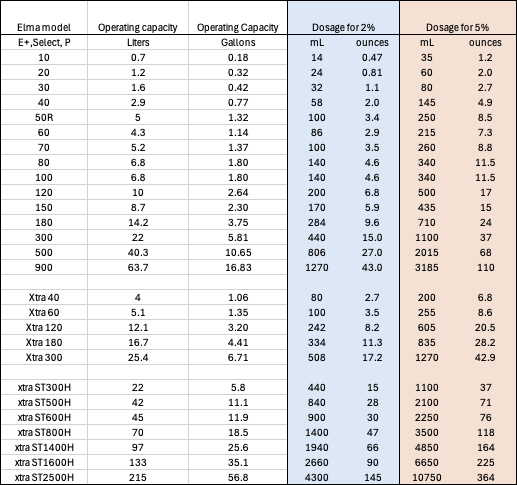
For more details on this important topic see Cleaning Solutions for Ultrasonic Cleaning Tasks.
Tips for Maximum Chemistry Efficacy
- Mixing Guide: Fill your tank half way with water, add the correct amount of concentrate for a full tank, then add water to the fill line. Turn on the unit, activate the degas mode to mix and degas the solution.
- Example: For a 10-liter tank at 5% solution use 500 ml of concentrate.
- The Hard Water Factor: If your tap water is very “hard” (high mineral content), your chemicals won’t work as well. Use Distilled or DI water for the mix to ensure the chemistry is 100% available to clean your parts.
- Evaporation Watch: Check solution level on a regular basis. Solution temperature increases as you operate the unit, with or without a heater. Use the tank lid to reduce evaporation and noise.
Additional References on Ultrasonic Cleaning
If the topic of ultrasonic cleaning is new or not that familiar, a good tutorial is How do Ultrasonic Cleaners Work?
Answers to tough cleaning challenges, extended cleaning cycles and cleaning large parts can be found in Selecting an Industrial Ultrasonic Cleaner.
Questions on selecting the correct ultrasonic frequency to use are answered in Matching Frequency to Cleaning Tasks.
More Questions? Ask the Experts
Tovatech, based in Plano, Texas, is the authorized U.S. reseller of Elma Ultrasonic Cleaners. Contact Tovatech’s staff of scientists and ultrasonic cleaning professionals if you have questions about
- Selecting and using an ultrasonic parts cleaner
- Ultrasonic cleaning accessories that support your tasks
- Cleaning solution formulations, and
- Product availability, warranty and service policies
Our experts will recommend safe, compliant, and effective cleaning systems tailored to your application.