
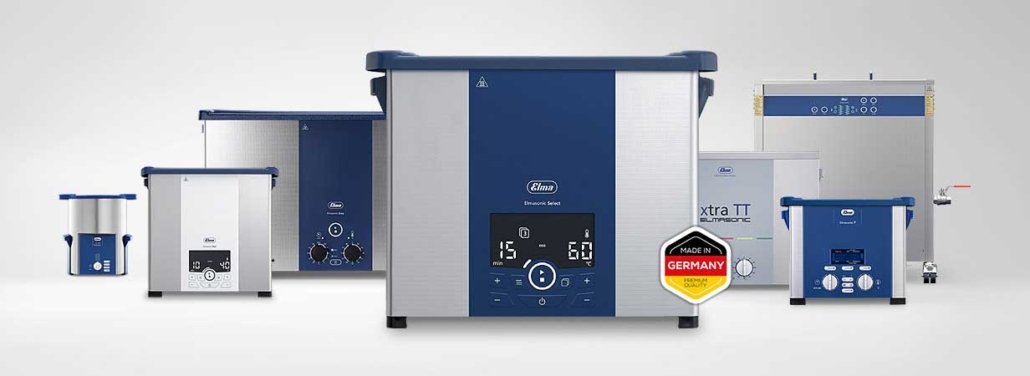
Selecting Your Best Ultrasonic Parts Cleaner – Six Steps to Success
Selecting the best ultrasonic parts cleaner depends on what you are cleaning and the contaminants being removed. Learn how ultrasonic cleaner tank volume, tank dimensions, operating features and cleaning solution formulas work together to help assure best results.
Chances are you’re here because you tried other ways to remove grime, grease and other contaminants from new or used parts and components of most any type. You found spray tanks, aerosol sprays, manually scrubbing using abrasives or flammable solvents and other alternatives unsatisfactory while raising environmental, health and safety concerns.
Chances are excellent that an ultrasonic parts cleaner can solve your problems. This post provides six steps to specifying a model meeting your needs. (For a tutorial on why they do a good job check “How do Ultrasonic Cleaners Work?”)
You will also find links to examples of successful ultrasonic parts cleaning applications.
First Step: Define the Task(s)
- What are you cleaning? quantity per cycle, size, shape, physical, chemical, mechanical properties (hard, delicate, complex, highly polished, heat sensitive…)
- Duration of operation. Is the unit operated occasionally as needed or continuously as part of a production line?
- Nature of contaminants: grease, oils, blood, suspensions, old paint, particulates, oxide layers, tarnish, burned or baked-on, tenacious, sticky, dense polishing compounds…
Answers Govern Steps
- Ultrasonic parts cleaner tank size and cleaning solution capacity
- Ultrasonic frequency selection
- Standard or industrial construction
- Features contributing to successful runs, and
- Cleaning solution formulas best-suited to the tasks
Second Step: Select Tank Size
Three Key Criteria:
- Tank size involves dimensions and cleaning solution capacity
- Cleaning is done in baskets with dimensions smaller than tank dimensions
- Do not stack or otherwise crowd parts in the cleaning basket
Why baskets? Cleaning baskets suspend parts at the optimum cleaning level above the tank bottom and protect the tank from contact with parts. Here are four tank size/basket size examples:
| Elmasonic Model | Tank Capacity (gal) | Tank Size (LWH”) | Basket Size |
| EP10H | 0.25 | 7.5 x 3.3.x 2.4 | 6.1 x 2.8 x 1.4 |
| Select 180 | 4.7 | 12.9 x 11.8 x 7.9 | 11 x 10 x 5.3 |
| Industrial Xtra 300 | 7.9 | 19.6 x 11.6 x 7.4 | 17.7 x 10 x 5.3 |
| Industrial xtraST 1600H | 42.8 | 23.6 x 23.6 x 17.7 | 18.8 x 20.7 x 11.8 |
Pro Tip: Elma’s modular baskets feature punched patterns on bottoms and side walls. Using a variety of pins, dividing walls, level sets and parts holders, you can position parts with unlimited flexibility, achieving maximum cleaning action.
Third Step: What Ultrasonic Frequency is Required?
Ultrasonic cleaners generate sound waves, typically in the range of 25 to 130 kHz, using transducers bonded to cleaning tanks. A popular frequency is 37 kHz as it covers a broad range of cleaning challenges.
Dual-frequency ultrasonic cleaners are available when requirements differ – such as cleaning delicate or highly contaminated parts. An example is the dual frequency, variable power Elma P180H unit. Select 37 kHz for common tasks or 80 kHz for delicate, highly finished parts. Large capacity ultrasonic cleaners such as the Elma xtra ST series offer 25 or 45 kHz for coarse and fine cleaning.
Fourth Step: A “Standard” or “Industrial” Ultrasonic Parts Cleaner?
If requirements call for production line cleaning with units in continuous shift operations, consider an industrial ultrasonic cleaner. Industrial units are offered as benchtop and mobile floor-mounted configurations as noted by two examples in the above table.
Key differences: Industrial ultrasonic cleaners provide
- welded (vs. pressed) stainless steel tanks with a 3-year warranty
- continuous operation up to 6 or 8 hours a day
- large-part cleaning capability
- optional peripherals on floor models for extending cleaning solution life and rinsing parts
Fifth Step: Features Contributing to Successful Runs
Far from sporting simple “on-off” switches, today’s ultrasonic cleaners offer a variety of features that go a long way to ensure successful parts cleaning cycles.
Here are features and benefits available on Elmasonic benchtop and industrial ultrasonic cleaners. Not all models offer all features.
| Ultrasonic Parts Cleaner Features | Benefits |
| Timers with auto shut-off | Set the length of your cleaning cycles |
| Heaters with timed or over-temp shut-off | Set recommended bath temperature |
| Degas Mode | Removes air from fresh cleaning solutions |
| Sweep Mode | Assures uniform cleaning action |
| Pulse Mode | Activate to dislodge stubborn contaminants |
| Dynamic Mode | Combine Sweep and Pulse for optimum results |
| Eco Mode | For quiet, gentle cleaning |
| Variable Power | To match properties of materials being cleaned |
| Programmable Cycles | Simplify setup for repetitive cleaning jobs |
Sixth Step: Correct Cleaning Solution Formulas Accomplish the Tasks
Know This: Tank size, dimensions and operating features/benefits aside, the ultrasonic cleaning solution formula orchemistry can be considered as the most critical step in the entire ultrasonic parts cleaning process.
Cleaning solution formulas directly determine the effectiveness, safety, and efficiency of your ultrasonic parts cleaning operation. Most formulas are offered as concentrates for economy and biodegradable to reduce or eliminate disposal concerns.
Pro Tip: Do not rely on dishwashing liquids or DIY mixes of soap, vinegar, citrus, or “purple” or “green” offerings if you have serious ultrasonic parts cleaning challenges.
Why? Because wrong formulations
- can fail to remove contaminants
- can damage parts you are cleaning, and/or
- could pose a hazard to operators.
Here are examples of cleaning challenges and cleaning solutions that solve them. For a more comprehensive guide check these popular cleaning solution formulations.
| Examples of Contaminants and Parts to Clean | Recommended Formula |
| Oil, grease, combustion residues, soot, dust, other organic contamination on engine parts and heavy machinery | elma tec clean A4 |
| Flux residues, polishing suspensions, grease, oil, dust, fingerprints on electronics and fine optics | elma tec clean A1 |
| Emulsions, residues of markings & labels, lime soaps, light greases, oils, fingerprints and dust on delicate laboratory equipment | Elma Lab Clean N10 |
| Oil, fat, grease, sweat, oxides, buffing compounds on ferrous and non-ferrous metals, precious metals, glass. Brighten brass & copper | elma tec clean A2 |
| Blood, tissue, ointments, bodily excretions on medical and dental instruments | Medclean C7 |
One More Thing:
In addition to the modular cleaning basket assemblies noted earlier in this post, you should be aware of the many ultrasonic cleaner accessories that can greatly improve the efficiency of your operations. And now as promised, here is a list of
Examples Where Ultrasonic Cleaners Shine
- Cleaning dental instruments before sterilizing or disinfecting
- Cleaning the intricate design of spray gun nozzles, internal passages, and delicate components
- An alternate method to cleaning microtube manifolds
- Removing contaminants from laboratory instruments, glassware and other components
- Maintaining the safety and operational efficiency of aircraft engines
- Solving maintenance challenges for costly plastic injection molds
- Cleaning new or restoring dirty printed circuit boards
- Removing grit, dirt, and grime from carburetors and other engine components
- In the lab as a sonicator bath for sample prep and cleaning fine mesh sieves
Need More Info on Ultrasonic Parts Cleaning?
Again we strongly recommend taking a look at How do Ultrasonic Cleaners Work? For help in making your selection. Other answers are found in ultrasonic cleaner frequently asked questions.
Contact an Elmasonic Cleaning Professional Today!
We offer additional information and recommendations on picking your ultrasonic parts cleaner, accessories, cleaning solution chemistries and operating tips. Call or chat with us today.
Additional Questions and Answers
Ultrasonic frequency is measured in kilohertz (kHz) and governs the size of the cavitation bubbles and the resulting cleaning power released when these bubbles implode. Ultrasonic power is a measure in watts of electrical power delivered to the transducers, which influences the quantity of cavitation bubbles formed. The relationship between ultrasonic power and cleaning effectiveness is complex and is discussed in Understanding Ultrasonic Frequency and Power.
Yes, but you need some other way to keep parts off the bottom of the tank. Small parts can be suspended in the solution from overhead hangers; large parts require an overhead crane or other support to avoid contact with the tank. Large capacity industrial cleaners can be equipped with part supports fabricated on the tank itself.
This can be complicated. Check this handy ultrasonic cleaning mixing guide for 2% and 5% dilutions.

