

How Ultrasonic Cleaners Work
Find out why ultrasonic energy as a cleaning technology is accepted by industry, R&D labs, service providers and private citizens as a fast, safe, environmentally friendly means of removing contaminants of most any type from any surface that can be safely wetted in an aqueous solution. Here you will learn how ultrasonic cleaners work.
Much like washing dishes, laundry, or your car or boat, an ultrasonic cleaner, combines water and a detergent (called a cleaning solution or cleaning formula) to remove grease, grime and other contaminants from objects being cleaned.
Links to typical ultrasonic cleaning applications are provided at the end of this post. But to the topic
Ultrasonic cleaners work by using the power of imploding (not exploding) miniscule bubbles in a process called cavitation created by ultrasonic transducers, which is explained below.
The process includes the use of biodegradable cleaning solution concentrates specially formulated for the cleaning tasks at hand. You can learn more about how these work in our post ultrasonic cleaning solution selection. Dilution and cleaning temperature instructions are provided by the manufacturers.
Components of an Ultrasonic Cleaner
Understanding how ultrasonic cleaners work calls for an understanding of their components. A Google search for these cleaners will reveal that models and pricing range all over the map. At the basic, however, these units consist of:
- Tanks to hold the cleaning solution. Tanks should be of stainless steel; their volume depends on the size of objects being cleaned
- Baskets to hold parts being cleaned
- Ultrasonic transducers (described next)
- A generator to power the transducers and
- Controls that govern a range of operating conditions described in Options to Consider
These cleaners range from small tabletop units to huge, multi-gallon industrial cleaners. The capacity of the cleaners has little or no bearing on the features they can offer – desired feature decisions are up to you, the purchaser. And please note, capacity is determined by tank dimensions and cleaning solution capacity. For more on this critical distinction, see Selecting an Ultrasonic Parts Cleaner.
What Do Ultrasonic Transducers Do?
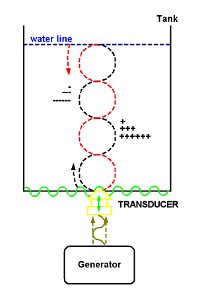
There are two basic types of transducers; piezoelectric (a.k.a. electrostrictive) or magnetostrictive, but their function is the same.
They are excited by electric current provided by the ultrasonic cleaner’s generator to vibrate at ultrasonic frequencies that cause the bottom (and sides as the case can also be) of the tank to vibrate and send sound waves through the liquid.
The sound waves cause the liquid to alternately contract and expand, forming waves of high pressure and low pressure. This phenomenon causes the liquid to “crack”, creating millions of tiny vacuum bubbles. These unstable bubbles implode violently (not explode) on contact with items in the ultrasonic cleaner tank, thereby loosening and carrying away contaminants.
There are also immersible transducers that are submerged in the tank and radiate sound waves from their surface. Ultrasonic frequency, or the frequency of the transducer vibration, is an important part of how ultrasonic cleaners work and is discussed next.
What Ultrasonic Frequency Do I Need?
Ultrasonic is typically defined as sound above the human range of hearing. Low frequencies such as 25,000 cycles per second or 25 kHz produce relatively large bubbles that implode more violently than those created at higher frequencies such as 37, 45 or 80 kHz that produce progressively gentle cleaning action. As an example, the radius of a cavitation bubble produced at 37 kHz is approximately 88 microns. At 80 kHz it is 41 microns.
Removing gross contaminants from robust parts such as fabricated or cast metals requires lower frequency cleaners. The overwhelming majority of cleaning tasks can be accomplished at 35-45 kHz. Delicate components and softer metals with polished surfaces should be cleaned at higher frequencies. In addition to protecting sensitive surfaces smaller bubbles are better able to penetrate tight areas such as seams and crevices.
If you’d like more information on this topic, check ultrasonic frequency selection.
Why You Need an Ultrasonic Cleaner Basket
Ultrasonic cleaners work best when cavitation bubbles access all surfaces immersed in the cleaning solution. This is best accomplished when parts are suspended in the solution.
Cleaning baskets, the dimensions of which are less than tank dimensions, hold the parts at the proper distance from the tank bottom. Here are four examples to illustrate:
| Elmasonic Model | Tank Capacity (gal) | Tank Size (LWH”) | Basket Size |
| EP10H | 0.25 | 7.5 x 3.3.x 2.4 | 6.1 x 2.8 x 1.4 |
| Select 180 | 4.7 | 12.9 x 11.8 x 7.9 | 11 x 10 x 5.3 |
| Industrial Xtra 300 | 7.9 | 19.6 x 11.6 x 7.4 | 17.7 x 10 x 5.3 |
| Industrial xtra ST 1600H | 42.8 | 23.6 x 23.6 x 17.7 | 18.8 x 20.7 x 11.8 |
- Pro Tip: Do not stack or otherwise crowd parts in the cleaning basket. In addition to reducing cleaning efficiency, this can result in damaged finishes.
- Pro Tip: Elma’s new modular baskets feature punched patterns on bottoms and side walls. Using a variety of pins, dividing walls, level sets and parts holders, you can position parts with unlimited flexibility, achieving maximum cleaning action.
Options and Accessories to Consider
Ultrasonic cleaners work best when they provide features that make the cleaning faster, more thorough and hence more efficient. A basic unit may have an on-off switch. Additional features offer additional benefits yielding desired results. Here is a brief rundown of those:
- Timers let you program the length of the cleaning cycle (often gained through experience) so you can set the time and do other tasks while cleaning takes place.
- Temperature controls let you set the cleaning temperature as recommended by the cleaning solution provider. Some units are equipped to provide auto-start when the set temperature is reached.
- Sweep Mode provides a slight ± variation in ultrasonic frequency that helps assure uniform cleaning action.
- Degas Mode drives off trapped air in fresh cleaning solutions that interferes with cleaning action.
- Pulse Mode delivers pulses of increased ultrasonic power to blast away tenacious contaminants.
- Eco Mode is selected for quiet, gentle cleaning action.
- Dynamic Mode automatically alternates between Sweep and Pulse to optimize cleaning.
- Ultrasonic frequency can be varied on certain units, letting users set the frequency best-suited for the job and thereby broadening the use of their ultrasonic cleaner. Examples are 25/45 kHz, 37/80 kHz.
- Ultrasonic power is controllable on certain models, also letting users set the best cleaning parameters for the jobs at hand. Some models have two power levels and others allow 10% increments from 30 to 100%.
- Safety shutoffs help protect the unit and contents against excess temperatures and overlong cleaning cycles that may cause cleaning solution evaporation below recommended levels.
Achieving cost-effective, efficiency-improving cleaning cycles is made easier when supported by the wide range of ultrasonic cleaning accessories.
Maintaining Your Tank: Handling Sludge, Oils and Hard Contaminants
Contaminants removed during the cleaning process either float to the surface, remain in suspension or sink to the bottom. Our earlier reference to cleaning solution selection goes into this in some detail.
Contaminants that float to the top should be skimmed off and set aside for later disposal. Some tanks are equipped with skimmers and weirs to direct floating contaminants to a collector. Large units can be equipped with filters to remove solid contaminants and further extend solution life.
The point is, eventually efficiency will fall and the solution must be drained and discarded, along with skimmed off and other contaminants, following local regulations.
When that time comes take the time to clean your ultrasonic cleaner tank following the manufacturer’s instructions. Prepare and degas fresh solution and you’re ready to resume cleaning.
Examples of Ultrasonic Cleaner Uses
- Removing paints, coatings and adhesives from spray gun components
- An alternate off-line method to replace laborious manual microtube manifold washing
- Cleaning and/or restoring jet aircraft engine components
- Removing contaminants from fine-mesh laboratory test sieves
- Safely removing burned or baked on contaminants from costly plastic injection molds
- Safe, gentle removal of contaminants from new and refurbished printed circuit boards
Contact the Elmasonic Experts for More Info on How Ultrasonic Cleaners Work
Our ultrasonic cleaning professionals are ready to help you select the ultrasonic cleaner, accessories and cleaning solutions that work best for your operations.
Additional Questions and Answers
Ultrasound heats cleaning solutions. Turn off the unit when not actively cleaning to allow cooling between runs. If the cleaning solution must be maintained at a relatively low temperature the use of a cooling coil attached to a source of chilled water is recommended.
Although ultrasonic tanks are fabricated from cavitation resistant stainless steel, over the long term a natural physical process of wear and tear occurs sooner or later depending on the operation and maintenance of the unit. Erosion is most likely to occur in the area around the transducers. It can be accelerated if abrasive particles remain on the tank bottom, with repeated use of low pH chloride-containing cleaning solutions, if the items to be cleaned are placed directly on the tank floor, or if the unit is run with a low liquid level.
Sonic bath monitors, the foil test and the pencil test are three methods described in “Validating the Performance of an Ultrasonic Cleaner.”
